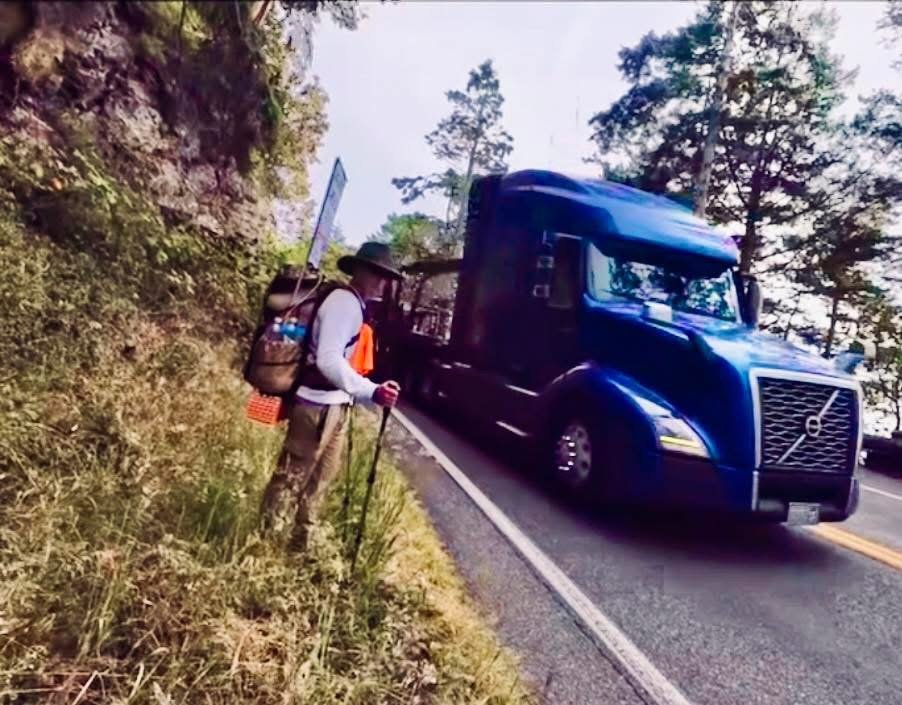
I’ve been thinking a lot about some of the near death experiences we had this round. In one of my closest calls yet, I was pushing through these blackberry bushes that were next to the shoulder to get as far away from traffic as possible.
Suddenly this truck comes barreling through them, off the road! I’m not sure why hitting gravel and plowing through the bushes wasn’t enough to alert the driver, but they jerked back onto the road once they spotted me; a moment later and I would’ve been toast. Interestingly, my determination to continue the walk didn’t falter, and this is because of my reformed relationship with death.
There’s a line from Epicurus that lingers in mind, “Death is nothing to us, for when we exist, death is not; and when death exists, we are not.” (Letter to Menoeceus). We picture death as something we’re going to experience, but by definition, it’s the end of experience. At least this form of experience. I feel that on the roadside now. Envisioning the truck hitting me, there wasn’t the fear I would have once experienced. But that’s because I now live intentionally and realize that what troubles us isn’t death itself; it’s the self, the ego, clinging to its own continuation.
That clinging creates a lot of unconscious suffering. We walk through life building up our identities. I’m a writer, we’re the Walking America Couple, I’m good at this, I’m bad at that, I prefer this, I prefer that. Layer upon layer. And naturally, as we cling tighter to our goals, preferences, and sense of identity in the world, separation from those attachments means greater degrees of suffering. But if you peel it back, first dropping titles, then dropping roles, then even dropping the sense of “me,” what’s left? Just being. Just life happening. There is a space within each of us devoid of attachment. That core doesn’t worry about death because it’s not invested in any particular story.
What we call “self” is really just suffering layered over stillness. All ego is disturbance atop the surface of consciousness. The moment we invent a “me,” we invent something to protect, something to lose. Beneath that is just pure awareness, undisturbed, unaffected. In fact, most of our suffering is the result of the ego we have constructed, protecting the story, protecting the version of ourselves it’s convinced us of being ourselves. But much like certain animals, we could exist without these conceptions of self, not thinking of death as the cessation of experience, experiencing each moment in its totality without the stories that we assigned to them.
Now, I don’t pretend to know if there’s something after this. Heaven, reincarnation, oblivion, none of it’s confirmed. But that doesn’t leave us rudderless. The best we can do is live by what Immanuel Kant called the moral imperative:
“Act only according to that maxim whereby you can at the same time will that it should become a universal law.” More colloquially put, in everything you do, do it the way you would have everybody else doing it, while aiming for the greatest good. That’s what this walk has been. We’re not about finishing some epic route; this is about living intentionally, in line with that sense of rightness, because that’s the only thing truly in my control, and perhaps the only thing that truly matters in life.
If there’s a creator or some larger system judging us after this life, then as long as I’ve lived by virtue (honesty, kindness, courage, temperance, love) I can let go of the rest. If I’m wrong, if the rules were different, that’s on whatever metaphysical system that decided to leave out a CLEAR instruction manual, not me. My responsibility is to live purely enough that I’m not carrying guilt. And living each moment wholeheartedly like that makes death all the more acceptable.
That freedom becomes ever more tangible when you realize life is only worth living because of death. Death doesn’t just end life, it gives it the meaning it has. It’s the frame around the painting. If we lived forever, days would blur together. Choices wouldn’t feel urgent. Experiences wouldn’t mean much. It’s precisely because my next step might be my last that I care so much about how I take it.
Let me not shrink back in the face of death, let me walk more boldly. Ironically, it’s not safety that delivers us the happiness we so pursue. Those who cling most tightly to safety, staying inside, avoiding risk, are those most likely to be deeply unhappy, feeling like islands amid a sea of threats. I’ve been that person too. Safety fetters experience to the mundane; it only keeps you alive, but that doesn’t mean you’re really living.
That’s the heart of it. When you have the right relationship with death, you unlock a clearer relationship with life. You live more intentionally and authentically. You love more freely. You experience more fully. You will never breach the entry way of a life well lived, if you are too busy running away from death. Death is the threshold over which you must come, if you would make your way into such sacred halls.