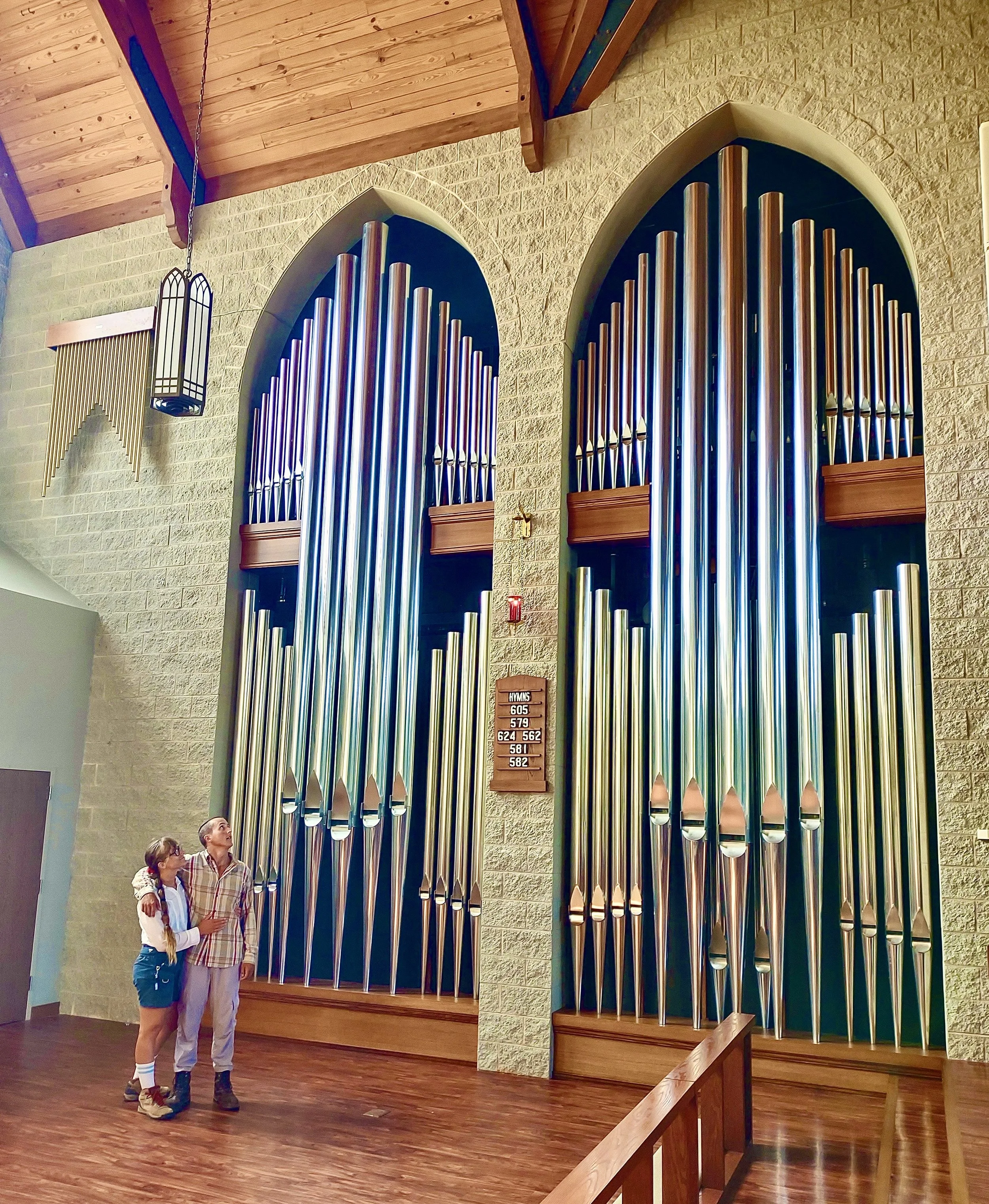
There are two things you’re never supposed to talk about in a public space like this, politics and religion! But does spirituality count? Trick question! We don’t care. Now let’s taboo it up!
What’s the big thing we’re here to discuss as the Walking America Couple? The way the mind transforms according to the thoughts we nurture and the environments we subject ourselves to. Wouldn’t you know it, spirituality has a tremendous impact on the way our brains function and transform! This has been of great interest to us, especially from the trends we see across the country.
Lisa Miller is a tenured professor at Columbia University and the founding director of the Spirituality Mind Body Institute, the first Ivy League program dedicated to spirituality in psychology, and some of her findings have been very enlightening!
She has published various papers throughout many different peer reviewed publications, including several showing that spirituality, or religious engagement, can help shield us from depression. Her work points to spirituality as neuroprotective in this regard.
In one of her most cited studies, she and her colleagues used MRI scans to compare people with and without a strong spiritual life, and found that those with a strong spirituality had thicker cortical regions in the prefrontal cortex and parietal cortex in areas tied to self-regulation, reflection, and perception of meaning.
These same regions are thinner in people with major depression, suggesting spirituality may provide a kind of neural resilience, or is at least correlated, in some way. Her lab also found that when people have certain spiritual practices, they activate a distinct network, overlapping networks used in emotion and cognition.
What does that matter? Well, it shows spirituality isn’t “just emotion” or “just thought,”the brain treats it like it’s its own mode of experience. That is to say, more than likely, if you’re having a spiritual experience, you’ll know it.
Some of her studies have also shown that spiritual engagement correlates with changes in reward circuitry. Thus, those with strong spirituality have lower rates of substance abuse, probably because spiritual experience provides alternative “reward pathways.” This lends a lot of weight to why AA wants you to lean on a higher power, and why so many religions are the catalyst which pulls someone away from their vice.
In her book The Spiritual Child, she even presents compelling statistics linking spirituality in children to improved well-being. She shows kids are 40% less likely to use or abuse substances. 60% less likely to experience depression during adolescence. And 80% less likely to engage in risky or unprotected sex.
Are you a seeker looking for vindication? Check out her distinction between what she calls the “achieving” vs “awakened” brain. One of the things she has demonstrated is that humans can toggle between two modes of brain function: Achieving, goal-directed, analytical, problem-solving (frontoparietal executive networks). And a more holistic, meaning-oriented perception tied to spiritual awareness (less default mode + salience networks).
We’ve all seen different ways spirituality can manifest. Some become all about the letter of the law, and the spiritual “grind”, while others open up, welcome more in, becoming more accepting and less judgmental, more present and attentive. People who cultivate “awakened awareness” show greater markers of well-being, fulfillment, and resilience to stress.
It seems spirituality opens up a qualitatively different mode of perception through which to experience the world. A reality we can attest to ourselves.
Am I seeing the awe in the day to day? The magic of experience and consciousness? The interconnectedness and interdependence of all things? Or am I waiting for the fulfillment of my current desire? Am I trying to work-out my salvation?
It makes me think of this book, The Sacred and the Profane, which I never finished, and which also introduced me to the idea of the hierophany, a manifestation or revelation of the sacred within the ordinary world. It’s when something from the “profane” world is experienced as a window to the sacred. And I’ll sandwich in just one more idea as the mayonnaise that holds it all together: Karma Yoga, or the path of spiritual practice through selfless action. The mindset is “I am not the doer; this act is consecrated.”
Together these ideas might turn us toward a life path, lived in the service of something greater, viewed through the lens of a greater reality. But what that reality is, neither she, nor we, nor any other person can tell you.
Surprise! Her participants come from all kinds of backgrounds! Christian, Jewish, Muslim, Hindu, Buddhist, secular, “spiritual but not religious.” Yet, she has consistently found that spiritual engagement of any kind is linked with lower depression, reduced substance abuse, and greater well-being.
Try as we might, it can be difficult to view the world through a spiritual lens. It’s all too easy to get swept up in the mundane, regular activities of life without seeing the magic in it all. But, whatever our inclinations, just as any other form of exercise requires intentional effort, we would do best to nurture a world view (a perceptual lens, if you will) that satisfies our God-shaped hole. It’s all that seems to scratch this neurological itch we share.
If all manner of spiritual views and practices do well to nurture our souls in such a way, may we at least find one which nurtures the souls of others just as well! One which remains awakened over apathetic, accepting over judgmental, and loving over… well, everything else!
To accomplish these aims, Paige and I look out at a world of religions as Rumi once said, “The lamps are many, but the Light is the same.”
Whatever outlook we nurture, let us find a way to look out at this world of enormously different people as diverse beads, woven together to make one big, beautiful tapestry.