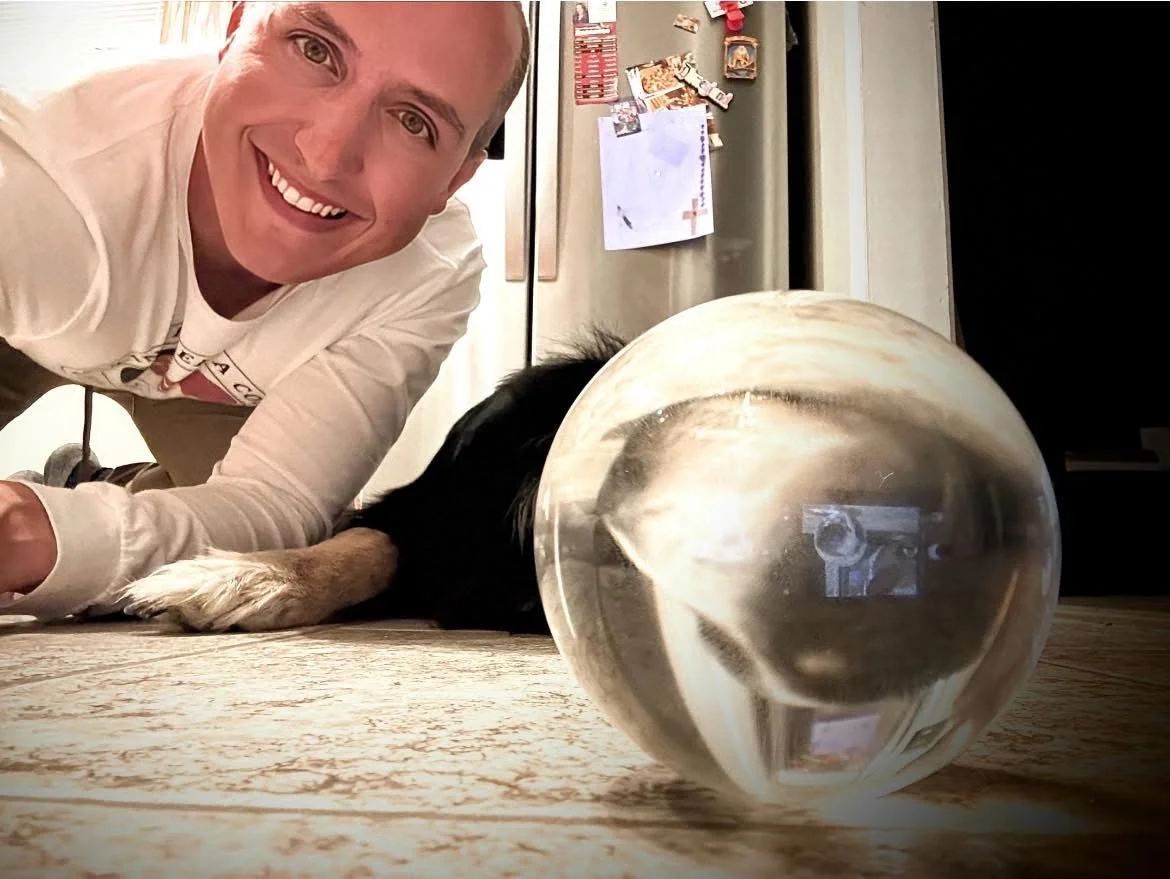
There was once a village nestled in the shadow of the Himalayas, where the clouds hung low and the wind whistled between the peaks. No one remembers when the temple appeared—it was simply there, etched into the stone like a birthmark on the earth’s face. And from the day a child first spoke, they were taken to it.
The ritual was quiet. The child entered the stone chamber alone. When they emerged, they held a crystal orb—small enough to fit in their palm, faintly glowing from within. It was theirs and theirs alone. It would answer their questions. Never fully, but usefully enough.
They each received but one. One orb. One lifetime. And so began the long slow dance between wonder and worry.
Lio was five when he first asked his crystal a question. “Will Papa come back before winter?” The orb clouded, swirled, and dimly flashed a hazy image—his father’s coat hanging on a wooden peg. Soon the seeds of belief were formed: The crystal knows. And as Lio grew, so did his questions.
“Will this girl say yes if I ask her to the festival?”
“Should I take this hunt?”
“Will my friend survive the fever?”
Each time, the answer came with fogged imagery and riddled hints—never certain, always suggestive. Yet over time, the crystal dulled. A faint line appeared across its surface, like a tiny fracture in glass.
Others had noticed the same. “It wears down,” some would say, always quietly, always after a glance over the shoulder, “The questions seem to chip at it.” But most asked anyway. It was too tempting. Better to know. Better to be sure. And as life went on they would turn to their crystal more frequently.
Like the others, as Lio aged he stopped laughing at surprises. He didn’t wander anymore. He didn’t stumble into stories or fall into love. He weighed every step, every word, against the crystal’s cloudy visions. By sixty, the orb barely glowed—dull as the expressions Lio wore. Answers came behind a murky fog. Even then, he asked.
“Should I plant again this year?”
“Is it worth trying to make peace with my son?”
He did his best to decipher the images—his actions always formed by his interpretations. But by then, the fracture had spread like a web across its surface, and it flickered like a dying ember.
The night it shattered, it made no sound. He simply looked down, and it was gone—cracked through. Its dim yet ever constant glow had finally vanished. No one came to console him. There was no ceremony. No mourning. There was only the climb.
The villagers knew only one course when their crystal’s visions ended. It was passed down not in words, but in silence. Each who lost their orb made their way to the mountain’s highest point, above the clouds where the wind whistled between the peaks. And they jumped.
Lio approached the ledge. But as he stood before it, something odd stirred…hope. “Certainly not all peoples have the orb,” he thought, “yet they live their entire life without.” For the first time in decades, he saw a future without answers. No whispers of suggestion. No possible certainties. But in that uncertainty, there was a kind of wonder.
He took a breath—not to leap, but to sit. And for a long time, he did nothing. Soon he began tossing rock after rock off the edge, watching the wind play with the stones.
He sat a while longer, and was soon met by a would-be dead man who’d come to claim the end of his days. But the man left and returned with a loaf of bread for Lio before jumping.
As Lio watched the body tumble, his heart began to fill with hate. Hate for the orbs. “They aren’t a blessing!” His mind chattered, “They are a curse!” But he sat a while longer, eating his bread. The sun yielded to the moon. The moon yielded to the sun. And a woman came to the edge.
“Don’t jump!” Lio screamed, “The orbs are cursed!” But he only claimed enough of her attention that their eyes would meet on her way down. Her glance spoke silently to him: They could have lasted. If we hadn’t clutched so tightly. If we had let mystery breathe. If we hadn’t sought so much control. If we had asked less and lived more.
Suddenly he realized: The crystals weren’t cursed. Humanity was.
It was then that he returned, inviting the villagers to go throw rocks off the edge with him.