Part 1: Messy Morals
What we think we know is one of our primary sources of division. But as we become more aware of how unlikely it is that we are actually right about any given thing, we become far more likely to lead with humility, curiosity, compassion, and openness, while avoiding judgment, condemnation, and premature punitive action. Being aware of our ignorance means embracing a more childlike relationship with the world. But instead, we go around believing “this ought to be,” and “that ought not be,” and “this is good,” and “that is bad,” or even worse, “these are good people,” and “those are bad people.”
As exploration and research have led our lives, the boundaries of these assumptions we construct have been further eroded with each new insight. Whether it involves exposure to many kinds of people, educating ourselves on different systems of ethics, or learning about the limitations of our own minds, we have grown to see that nothing is truly black and white. In this article, we’ll be taking a look at the gray area of certain ethical dilemmas, many of which you will likely come out on one side or another. But throughout the rest of our series, we’ll further explore why you might not want to trust that initial certainty.
Take stealing for example. Most would call it wrong, full stop. But what if a starving parent steals bread to feed their child? What if it’s through no fault of their own that they needed to in order to keep them alive. Many throughout history have been seated beneath such greedy and authoritarian rule, there simply was no other way to keep their children fed. Even in the first world, however, it’s possible that all the wrong events might befall you. Perhaps a hefty savings account was depleted by the bills associated with your child’s leukemia. Perhaps your relatives and friends have died off or abandoned you, you have nothing to fall back on, and your otherwise lucrative corporate job has laid you off arbitrarily. The economy has gone bust, and it’s just taken too long to find work despite being otherwise qualified. Is the act immoral, or is it the fault of an unjust system that forces such choices? Our judgments can quickly shift depending on how far we’re willing to zoom out.
What about lying? It’s easy to say honesty is always the best policy, but what about hiding someone from persecution? What about sparing a child from unnecessary fear? Take a moment to imagine a child showing you a drawing they worked on for hours. It’s messy, disproportionate, and objectively not impressive by adult standards—maybe not even that of other kids. They beam up at you and ask, “Do you like it?” In these moments, truth-telling can feel like betrayal, while deception seems like an act of care.
History itself is full of stories that defy simple moral labels. In 1983, Stanislav Petrov, a lieutenant colonel in the Soviet military, received an alert that the United States had launched nuclear missiles toward Russia. Protocol demanded immediate retaliation. But Petrov refused to push the button. As luck would have it, it turned out to be a false alarm. He trusted his gut and disobeyed direct orders, becoming the man who prevented a nuclear holocaust. Millions of lives were spared because he chose to do what his superiors, equals, community—perhaps even friends and family—might have considered the “wrong” thing.
Remember the Crusades? Framed as a holy mission, they were praised as righteous by those who led them. Yet they unleashed centuries of slaughter, conquest, and suffering. What was preached as good, and seen as good by the culture’s majority, is now viewed as an atrocity.
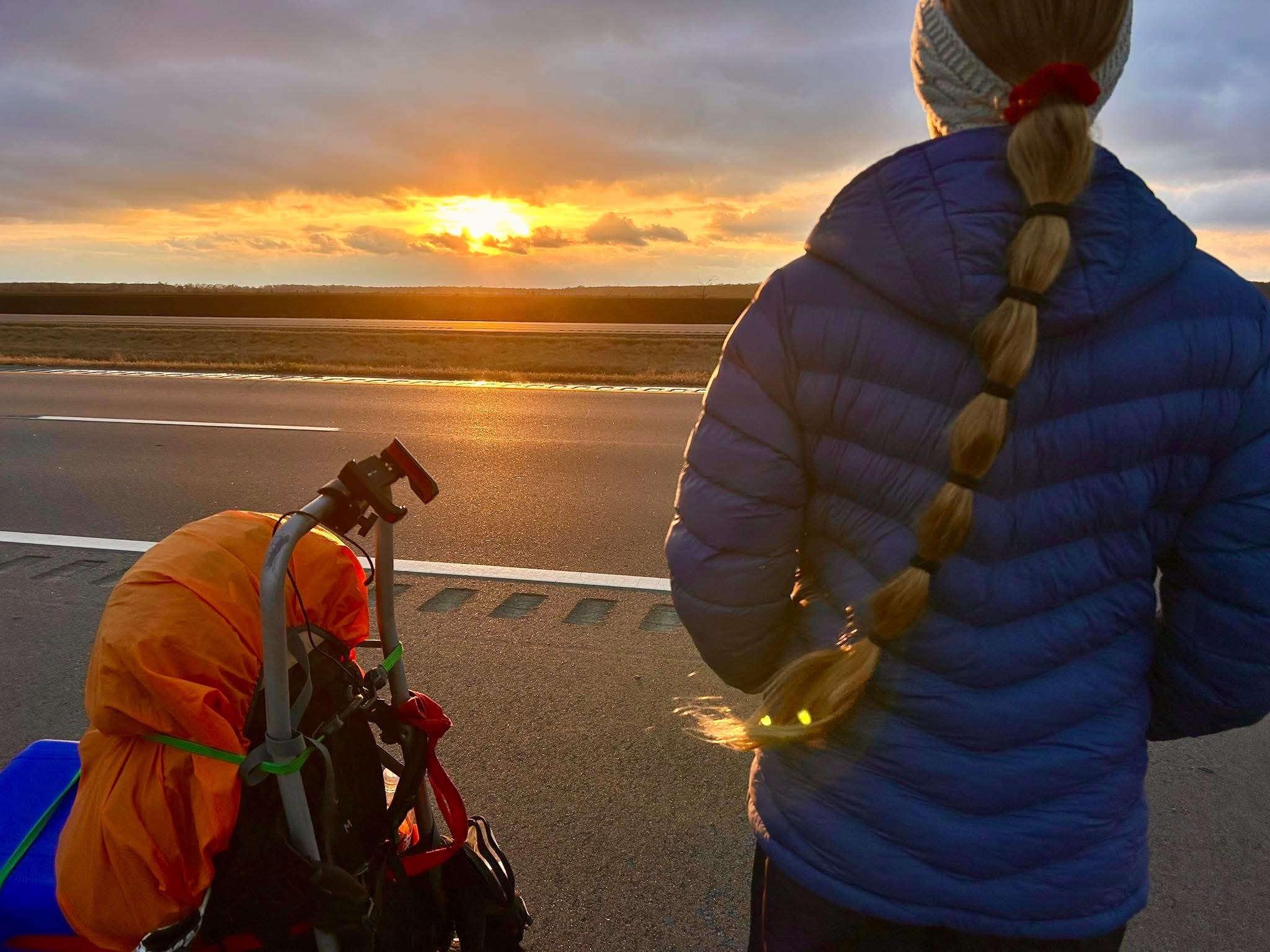
We bumped into a related example of this on the walk. We met someone biking through the states—a psychoanalyst from Austria. That night, our host, hosting both the Austrian and us, asked him, “Haven’t you found there are so many more good people than you expected in your travels?” He paused. “I don’t like the term good people,” he said. He went on to tell us about his life growing up. It was rather normal—a stable, loving family, a father and mother who cared for him—yet his father served as a Nazi during the holocaust. He had entered the field of psychology to figure out why such seemingly “good people” could be made to do such terrible things.
Well intentioned or not, we are deeply shaped by our environment. Behaviorism is the study of this very phenomenon. B.F. Skinner’s work emphasized how our behaviors are reinforced or discouraged by external factors. A person raised in an environment where certain actions are normalized, regardless of their moral implications, will typically come to see those actions as acceptable—even if, from an outside view, they are atrocious. Our environment leads to groupthink, often without us ever realizing it; this describes the way individuals are shaped by the pressures and expectations within a group, leading them to make decisions that may go against better, individualistic judgment. These external pressures—such as the influence of authority figures, fear of isolation, the bandwagon effect, or the pull of a shared belief system—can lead individuals to suppress doubts and follow the group’s actions, even when they would otherwise recognize them as dangerous or irrational.
An easy example of this is Heaven’s Gate. Members were persuaded by their leader that the Earth was about to be “recycled” and that the only way to survive was to ascend to a UFO traveling behind the Hale-Bopp comet. The group’s environment, including constant ideological reinforcement and isolation from outside influences, pressured members into blind obedience. Despite the extreme nature of the beliefs, they followed through with lethal resolve, taking their own lives in 1997, demonstrating how groupthink can push individuals to commit actions that are unthinkable when considered outside of the group’s influence.
While there are striking examples such as Heaven's Gate or Jonestown (yet another example and the inspiration behind the phrase “drinking the kool aid”) these same mechanisms are at play against us no matter where we are, and we can never be sure just how much our environment has shaped our reality.
Looking to the present, debates around whistleblowers like Edward Snowden reveal the tension between intention and consequence. He exposed government surveillance, believing it was the morally right thing to do. Some hail him as a hero; others label him a traitor. Is he good or bad? It depends on which side of the ethical scale you value more—his intention to protect civil liberties or the potential harm caused by his disclosures.
Consequentialist ethics would say outcomes determine right and wrong. If the results bring about the most happiness or the least harm, the act is justified. Whereas more intention-based ethics, like those of deontology, argue that the morality of an action lies in the motivation behind it, regardless of the outcome.
So which is it? If someone saves a life but had intended harm, are they praiseworthy? If they try to save a life but inadvertently end it (such as moving someone from an accident when they imagined time was of the essence but should have left them still while waiting for help) are they blameworthy?
Peter Singer takes this tension a step further by arguing that ordinary people—those of us who see ourselves as “good”—are, in fact, complicit in evil. His famous “drowning child” thought experiment makes the case plain:
Imagine you’re walking past a shallow pond and see a child drowning. Saving them would ruin your clothes and make you late, but most of us wouldn’t hesitate. The minor inconvenience clearly means nothing compared to the child’s life.
But now consider that for the cost of a nice dinner or a new pair of shoes, you could donate to a charity that provides life-saving resources to children. Still, most of us aren’t forgoing the majority of our pleasures to this end, even if we engage in charitable acts regularly. From a consequentialist standpoint, there’s no moral difference between ignoring a drowning child in front of you and ignoring one halfway around the world. Both are lives lost because we prioritized our own comfort and pleasure.
Singer’s argument is uncomfortable precisely because it exposes the fragility of our moral self-image. We judge the negligent bystander harshly, yet most of us live like them every day.
Some try to reconcile this with arguments pertaining to proximity, but really, there’s no clean answer. Ethics is messy because life is messy. The more you explore, the more it becomes clear: certainty is only perspective—a feeling constructed by our mind, but nothing indicative of reality.
But more than anything else, that should humble us.
You Know Nothing Part 2:
The Limits of Seeing
How can we be sure that what we believe is true? The truth is, we can’t! Of course, if you believe that, there’s really no good reason to believe that.
Every aspect of our conscious “reality”—concepts, ideas, and our image of the world—is the result of inadequate senses feeding us an infinitesimally small portion of the available data, and then sending that through a brain that filters, edits, reconstructs, and fills in the gaps, crafting an experience of reality that is more misleading than true.
Forever and a half ago, that ancient philosopher by the name of Plato told us the allegory of the cave. In this cave prisoners have spent their lives since birth staring at a wall which catches just a sliver of the outside light, mistaking shadows cast by unseen objects for reality itself. They would make up stories about these shadows, and soon the stories too became seen as reality. We’d like to believe we’re different—that we see the world as it truly is. But the evidence tells a different story. We’re going to start with the tangible beginning to our illusions, our senses.
Did you know, we can only detect about 0.0035% of the electromagnetic spectrum with our vision—roughly 380-700 nanometers. Yet, some animals can see far beyond this range. Birds, bees, and reindeer, for instance, can perceive ultraviolet light, enabling them to find food more easily, spot patterns on feathers or flowers that are invisible to us, and even detect predator urine. Similarly, certain snakes and beetles see infrared light, allowing them to detect the heat signatures of their prey.
This is just a small sample of the external reality we miss. Regardless of the sense we consider, our sensory equipment is far from optimal. For every one of our senses, there’s another life form that’s better equipped. In some cases, animals are attuned to parts of reality we can’t access at all. Why is this relevant? Because we walk about the earth so sure of ourselves when, like our perception of the light spectrum, we only perceive a tiny fraction of reality. But unlike the light spectrum, the fraction of reality we actually experience can only be smaller due to the unknowns we still have yet to identify; we just have no idea how insignificant that fraction truly is. As usual, let’s dive deeper!
Humans hear sounds between roughly 20 Hz and 20,000 Hz, but other animals like bats, dolphins, and dogs can hear much higher frequencies. Meanwhile, elephants and whales communicate using infrasound—frequencies beneath our threshold of perception. Yet more aspects of the world that remain hidden to us.
Dogs possess up to 300 million olfactory receptors, whereas we only boast a relatively minuscule 5-6 million. Their sense of smell is so sensitive that they can sometimes detect certain diseases, such as cancer, track individuals across great distances, and even sense emotional states based on hormonal changes. Our own perception of scent is a dull fraction of what many animals experience.
We could also explore touch and taste, but as you might expect, these senses too only capture a small portion of those of other animals. The diversity of sensory abilities across species is staggering, and reveals that humans are not the benchmark for perception. In fact, our senses are even more limited than we realize. There are entire layers of reality that we have no access to, while other animals not only perceive them but rely on them. This is where things get truly strange. Some animals possess entirely different senses that allow them to access parts of the world we can’t even imagine.
Certain insects, birds, and sea turtles rely on magnetoreception—the ability to perceive Earth’s magnetic field. To do this, they use specialized organs. Many birds, for example, have cryptochromes, proteins in the retina that are informed by quantum effects, where the spin of electrons in the protein changes depending on the bird’s orientation relative to Earth’s magnetic field. Some also have magnetite in their beaks—magnetic iron oxide crystals that align with Earth’s magnetic field, transmitting information to the brain via connective nerves. We can measure Earth’s magnetic field with tools, but these animals can perceive it directly within their consciousness in a way we can’t.
Meanwhile, many aquatic animals, such as sharks and rays, possess electroreception, the ability to detect electric fields. Sharks use jelly-filled pores to sense the electrical fields produced by muscle contractions in prey, allowing them to hunt even in complete darkness or when their prey is buried under the sand. The platypus, on the other hand, hunts underwater with its eyes, ears, and nose closed, relying on receptors in its bill that detect electrical signals produced by the movements of its prey.
These senses seem almost otherworldly to us. We can’t even imagine what it might be like to plug into a consciousness capable of perceiving such things, just as a blind person can’t imagine color without having once seen it. Yet, they are not anomalies—they are just part of the biological toolkit of these species. When we consider how these abilities allow animals to navigate, hunt, and interact with their environments in ways humans can’t, we are reminded of the vastness of the world beyond our perception. Oh, and as we continue forward, things are only going to get weirder! But before we get too into the weeds, let me direct attention back to the purpose of this series.
The reason this information is so important is because we are inclined to go through life thinking we experience reality as it is. But nothing could be further from the truth. We are like a receiver, processor, and screen. Our sense organs receive the information, that information is then processed by the brain, and the resulting construction is then projected onto the screen of awareness—the contents of our consciousness.
Like the screen, there is still a huge part of the picture we’re missing. A screen can’t inform you beyond that fraction of the visual and auditory picture it provides, just as your mind can’t inform you beyond the picture your brain and senses provide. Yet we all know, lurking behind the screen is all manner of illusion—missing background context, editing, enhancement, reconstruction, and at times entire fabrications.
To understand this sliver of reality we observe means staying humble. Animals aren’t simply less evolved or less intelligent; they experience the world differently—not simply more ignorantly, but often more precisely. For example, while humans rely on their vision to navigate and interpret the world, a bat uses echolocation to perceive the world in 3D space, even in complete darkness. Where we might see a static image, a bat hears the environment as a dynamic, constantly shifting soundscape and constructs an image of it from entirely different mechanisms and data than we do.
And as for us humans? We lack the faculties to judge reality with any real accuracy. The mind doesn’t present an objective picture of the world—it is inherently, intrinsically subjective. Our perception and impressions are the result of senses that only give us access to a small fraction of the information available, which are then processed by a mind that constructs a mere representation of our external environment. And even when we think we understand what we perceive, we’re often wrong. Our sensory and processing systems can be tricked, edited, and manipulated, leading us to believe we are perceiving the world “as it is” when, in reality, we are experiencing only a tiny slice of it—but this is the subject matter of another entry in the series.
This all should be humbling. When we go about our daily lives, making decisions and interacting with others, we do so with the understanding that our version of reality is “the” version. But it’s not. We are constrained by our senses and our brains’ limited ability to process the data we receive. The next time you find yourself certain of something, remember: your perception is an incredibly limited part of the whole—and what you can’t perceive is only ever more significant than what you can.
You Know Nothing. Part 3:
Illusions in Sight
I remember being totally fascinated as a kid when dipping a straw in my drink. The moment it touches the liquid, the straw appears to be in two different places? What??? You know it isn’t actually. But in that moment, your brain is clearly showing you an image of reality that isn’t true.
This is a minor deception, one we can easily perceive. But, in truth, our entire experience of the world is built out of illusions we never notice. In fact, it is more accurate to think of ourselves as hallucinating reality, than it is to imagine we see things as they are.
Once our brain receives the tiny portion of environmental data through the limited senses we previously discussed, it then constructs an image out of it. But it is just that, a construction. The brain is not a passive receiver of reality—it’s a sculptor, reshaping, editing, and distorting sensory input to manufacture something useful.
Other optical illusions provide similarly concrete evidence for this, like the Müller-Lyer effect, where two identical lines appear to be different lengths due to the direction of the arrows at their ends. But not everyone sees it this way. People from Eastern cultures, particularly those with less rectangular structures in their environment, don’t usually have this problem like we do in the west. Another great example is that of the checkerboard color illusion, where two squares that seem to be vastly different shades are, in fact, the exact same color. These aren’t merely optical illusions—they’re examples of how the brain actively alters what we see to fit patterns it expects. And unnervingly, we can be primed to see one thing or the other based on how we’re primed, immediately, culturally, or by context. Here are some other examples.
•Rubin’s Vase / Face-Vase Illusion – Depending on what you're told you’ll see or how you focus, you either see a vase or two faces in profile. Your brain switches between the two interpretations but, interestingly, can’t perceive both simultaneously.
•The Old Woman / Young Woman Illusion – A famous ambiguous drawing where some people see an elderly woman, while others see a young woman. Once you’ve been “primed” to see one, it can be difficult to unsee it.
•The Duck-Rabbit Illusion – A classic example of perceptual priming. Depending on context (or even the time of year—people are more likely to see a rabbit around Easter for example), the same image appears as either a duck or a rabbit.
•The B/13 Illusion – A certain ambiguous image placed in a sequence of numbers (A, B, C) or a sequence of digits (12, 13, 14) will be perceived either as the letter “B” or the number “13” depending on context.
•The Dress (Blue/Black vs. White/Gold) – This viral phenomenon showed how lighting conditions and prior experience could dramatically change color perception. People could be primed by ambient light exposure to interpret the dress in one way or another.
Our brains apply the same filtering and distortion to everything. We recognize faces faster than any other pattern, but this ability can betray us. Pareidolia makes us see faces where there are none—on clouds, electrical outlets, burnt Jesus toast—while prosopagnosia (face blindness) prevents some people from recognizing their own family members, even their own faces. Interestingly, this is something that can happen in the middle of your life simply due to a bad bonk on the head. The same mechanisms that help us construct a coherent world can also strip us of fundamental perceptions of reality and perceive realities that were never there.
Pareidolia falls under the broader phenomenon of apophenia—the brain’s tendency to perceive patterns and meaning in random stimuli. While pareidolia specifically involves seeing familiar shapes, apophenia extends to the broader tendency of mind to seek meaning within whatever information it’s presented. These aren’t disorders but our pattern-seeking instinct, our mental mechanisms which we use to make sense of the world. While useful for survival, these same mechanisms lead to delusions in ordinary, healthy people. Here are some common examples:
•Religious Apparitions – People frequently see the Virgin Mary, Jesus, or other religious figures in everyday objects like toast, tree bark, or water stains. These often reinforce spiritual beliefs and can even lead to large pilgrimages or the veneration of inanimate objects.
•Shadow People – Many believe they’ve seen these dark, humanoid figures which feel ominous and “real,” even though they are likely the brain misinterpreting vague stimuli in low light. Some people become convinced they are being watched or haunted by them.
•UFO Sightings & Alien Encounters – Many reported UFOs turn out to be Venus, satellites, or aircraft lights, but pareidolia causes people to “fill in the blanks,” seeing structured ships or beings where none exist.
•Electronic Voice Phenomena – Ghost hunters and paranormal enthusiasts often claim to hear voices in white noise, static, or radio interference. The brain is wired to detect patterns in randomness, leading people to believe spirits are communicating with them.
•The Number 23 / Pattern Recognition in Numbers – Some become obsessed with seeing a specific number (11:11 on clocks, or the “23 enigma”), certain it holds cosmic significance. This is a form of apophenia, where randomness is misinterpreted as meaningful. And bonus note! This topic resulted in one of Jim Carey’s few serious roles: The Number 23
•Conspiracy Thinking – Apophenia, along with various cognitive biases such as subjective validation, fuel the belief that unrelated events are secretly connected. People are regularly connecting symbols, news events, or celebrity deaths into a grand hidden narrative, despite no falsifiable (testable) evidence linking them. Most conspiracy thinking can be easily attributed to the way our mind works.
•Faces in Surveillance Footage / Blurry Images – People “see” criminals, ghosts, or monsters in blurry images or low-resolution security footage, leading to false accusations or panic. Many reports of Bigfoot, the Loch Ness Monster, or other cryptids come from people misidentifying logs, shadows, or animal shapes in unclear conditions. Pareidolia causes the mind to complete the picture. This is why eyewitness testimony based on vague visual data is notoriously unreliable.
•Backmasking & Hidden Messages in Music – Some claim to hear satanic messages or hidden phrases in reversed songs or random noise, a form of auditory pareidolia. The brain imposes meaning on ambiguous sounds, making nonsense seem intentional.
Just like the visual examples, priming plays a huge role here as well. I encourage you to look up the Yanny vs Laurel and Brainstorm vs Green Needle videos which show that in spite of it being the same ambiguous sound, most people will hear the word which is displayed on screen. This is an example of auditory pareidolia.
Maybe all of this sounds like harmless intellectual curiosity—just another collection of interesting quirks about the brain. But the implications are far more serious than we tend to acknowledge. We live in a world where algorithms study our behavior, feeding us tailored information that reinforces what we already believe. Meanwhile, entire industries—advertising, politics, behavioral economics—are built on understanding and exploiting the very cognitive tendencies we’ve just explored. People go to school to study behaviorism, psychology, and decision-making, not just to understand the mind, but to manipulate it. Marketers know how to prime you, politicians know how to frame narratives, and corporations know exactly how to exploit your biases to keep you engaged, outraged, and spending. These illusions don’t just affect how we see a straw in water or a face in the clouds—they shape our politics, our fears, our sense of right and wrong. And if we can be so easily deceived about the reality in front of us, how can we be so certain that we are the ones who have it right, and they are the ones who are wrong? Recognizing the fallibility of our own minds is not just an exercise in humility—it’s a responsibility.
You Know Nothing. Part 4:
How Long is a Moment?
We’ve all experienced distortions of time. A car crash happens in slow motion. A long-awaited vacation vanishes in a blink. As we age, years seem to fly by. At times, time feels constant, moving forward in hours, days, and years, ticking by at a steady rate. But this perception is an illusion. Time as we know it is actually something our brains construct. And the more we examine it, the clearer it becomes that time is not what we think it is. These distortions aren’t just tricks of memory—they reveal something deeper. Our perception of time isn’t fixed. It bends, warps, and changes. In fact, time itself bends, warps, and changes depending on speed, gravity, and our own biology dictates our perception of it. The universe does not tick to the rhythm of human experience. The universe is far more extraordinary than that.
Biologically, scientists have studied how different animals experience time using a method called the critical flicker fusion test. This measures the rate at which an animal perceives individual flashes of light before they blur into a continuous glow. The higher the rate, the faster an animal processes visual information—and the slower the world appears to them. To determine this, researchers often train animals to respond when they detect flickering. For example, in experiments with birds, scientists might reward them for pecking or moving toward a flickering light source. By systematically increasing the flicker rate, they identify the threshold at which the animal stops responding to flicker, indicating that it perceives a steady light instead. When direct training isn’t possible, scientists use electrodes to measure brain activity in response to flickering stimuli.
Does it sometimes feel impossible to swat the pesky critters? That’s because flies see at a much higher frame rate than humans, around 300 frames per second, compared to our 60 frames per second. This allows them to react to danger with seemingly impossible speed. To a fly, our sluggish movements likely resemble a slow-motion film. On the other hand, animals with slower metabolisms, such as certain amphibians and reptiles, experience movement at a different pace, likely perceiving us as moving much faster than they do—something probably akin to a fast-forwarded film.
Thus, time is not universal, even within biological life. It’s a function of perception, dictated by the nervous system’s ability to process sensory input. If different creatures experience time differently, then which version is “real”? More importantly, we as humans experience time differently. Sure children experience it more slowly and as we age it speeds up, but even emotion, attention, brain chemistry, neurotransmitters, and disorders as commonplace as adhd, depression, and anxiety all alter our sense of time to variable degrees.
If time and our sense of it were absolute, it would pass the same for everyone, everywhere. But guess what! Even physics tells us time is no straight arrow. Time dilation, first evidenced by Albert Einstein’s special relativity, proves that time is relative—it slows down and speeds up depending on motion and gravity. And this isn’t merely speculation, we can predict for it, and demonstrate it.
A striking real-world example of this is Sergei Krikalev, a Russian cosmonaut who spent 803 days in space. Since he orbited Earth at high speeds, time passed slightly slower for him than for people on the planet’s surface. When he returned, he was about 0.02 seconds younger than he would have been if he had stayed on Earth. Time dilation of this sort is something scientists are able to measure with incredibly precise atomic clocks. In fact, if we didn’t account for it, the satellites which feed your phone the time would be out of sink with each other and earth time. They have to adjust for time dilation. And although this difference is small, at fast speeds and larger scale the differences become unfathomable.
If an astronaut traveled close to the speed of light and returned to Earth from some vast distance, they would have aged only a few years while centuries passed for those they left behind. Gravity also plays a role—time moves slower in stronger gravitational fields. This too was famously tested by placing two synchronized atomic clocks at different altitudes; the clock closer to Earth’s surface, where gravity is stronger, ticked more slowly. For those of you who have seen it, this is why in the movie Interstellar, the crew returns from a couple of hours on one planet to their shuttle and finds that the crew member in orbit has aged into an old man.
This indicates that time is not an independent force but more like a dimension we rest in—one that changes depending on velocity and gravitational fields. Our perception of time as a steady flow is just that: a perception, not reality.
Not only does time warp at cosmic scales, but it also bends within our own minds. Neurological changes can drastically alter how we perceive time.
We touched on some of this briefly but let’s sink our teeth into just how dramatically different time can be experienced between individuals. In moments of extreme danger, like car accidents, time appears to slow down. This isn’t because reality changes but because the brain processes more information per second, increasing awareness and creating the sensation of stretched time. Certain illicit substances also alter the brain’s processing speed, causing time to dilate or contract. Users report that a few minutes might feel like hours, or vice versa. As we grow older, time seems to speed up. One explanation is that new experiences create lasting impressions, while routine experiences blur together. Since childhood is filled with novelty, time feels stretched, but as we age and fall into repetitive patterns, time appears to shrink. On the walk, this is readily apparent. Squeezing so much novel experience into a couple of months can feel like years of time. Then we go home, burn through a few weeks, and it’s like, “where did it go?” This seems like a good reason to never be too routine.
All of this points to a simple truth: time, as we experience it, is not real. What we experience is just a function of the mind, a construct of biology and physics working together to create the illusion of continuity.
But if time is an illusion, what does that mean for us? Well, it means we never perceive anything as it truly is, and our version of reality is a sort of distorted reconstruction, an experience of something we can never know directly, an experience tailored by our senses and our brains to help us survive—not some window to objective truth. Just as a fly’s version of time differs from ours, and an astronaut’s differs from someone on Earth, there is no single, universal experience of time.
This realization should humble us. It dissolves the rigid boundaries we place between ourselves and others, between our experiences and the greater reality beyond them. If even time—a fundamental aspect of existence—is not what it seems, how much else do we misunderstand?
The more we grasp the limitations of our perception, the more we can let go of the delusions of certainty which divide us. We cling to rigid ideas of self, time, and existence, believing in an objective reality that simply doesn’t exist in the way we assume. But accepting this uncertainty is liberating. It frees us from the illusion that we fully understand the world and allows us to approach life with curiosity, openness, forgiveness, and a deeper sense of wonder.
You Know Nothing: A Closing Reflection
We spend our lives piecing together a story of the world, using the best tools at our disposal: sight, sound, memory, thought, emotion. We call this story reality. But what we’ve seen, again and again, is that reality is not something we directly perceive—it’s something we assemble out of distorted data. Everything: time, space, selfhood, morality, and even truth itself pass through filters too narrow and brains too biased to ever deliver the full picture. We think we know what’s real, but we don’t.
A fly dodges your hand because it lives in a faster world. A cosmonaut ages differently because gravity warps time. A child lives in slow wonder; an adult blinks and a decade vanishes. Our brains stitch together illusions of order to survive, not to see clearly. And if that’s true for something as foundational as time and personhood, what else might we be wrong about?
This isn’t meant to frighten you. It’s meant to free you. If we can’t see ourselves as we truly are, maybe we can stop judging so quickly. Maybe we can stop assuming the worst in each other. Maybe we can let go of the urge to be right, and start listening to the ways other people experience the world—because even if they’re wrong, so are we. Just in different ways.
We’re not built to know everything. We’re built to wonder. And the moment we stop pretending we’ve figured it all out, we make space for awe again—for compassion, for curiosity, for forgiveness. We remember that every person we meet is a mystery, including ourselves.
Let unknowing soften you. Let it humble you. Let it widen your eyes.
You can never be sure you’re right.
You were never meant to understand it all.
You were only meant to be here,
for this breath,
in this moment,
being your best for the people around you.