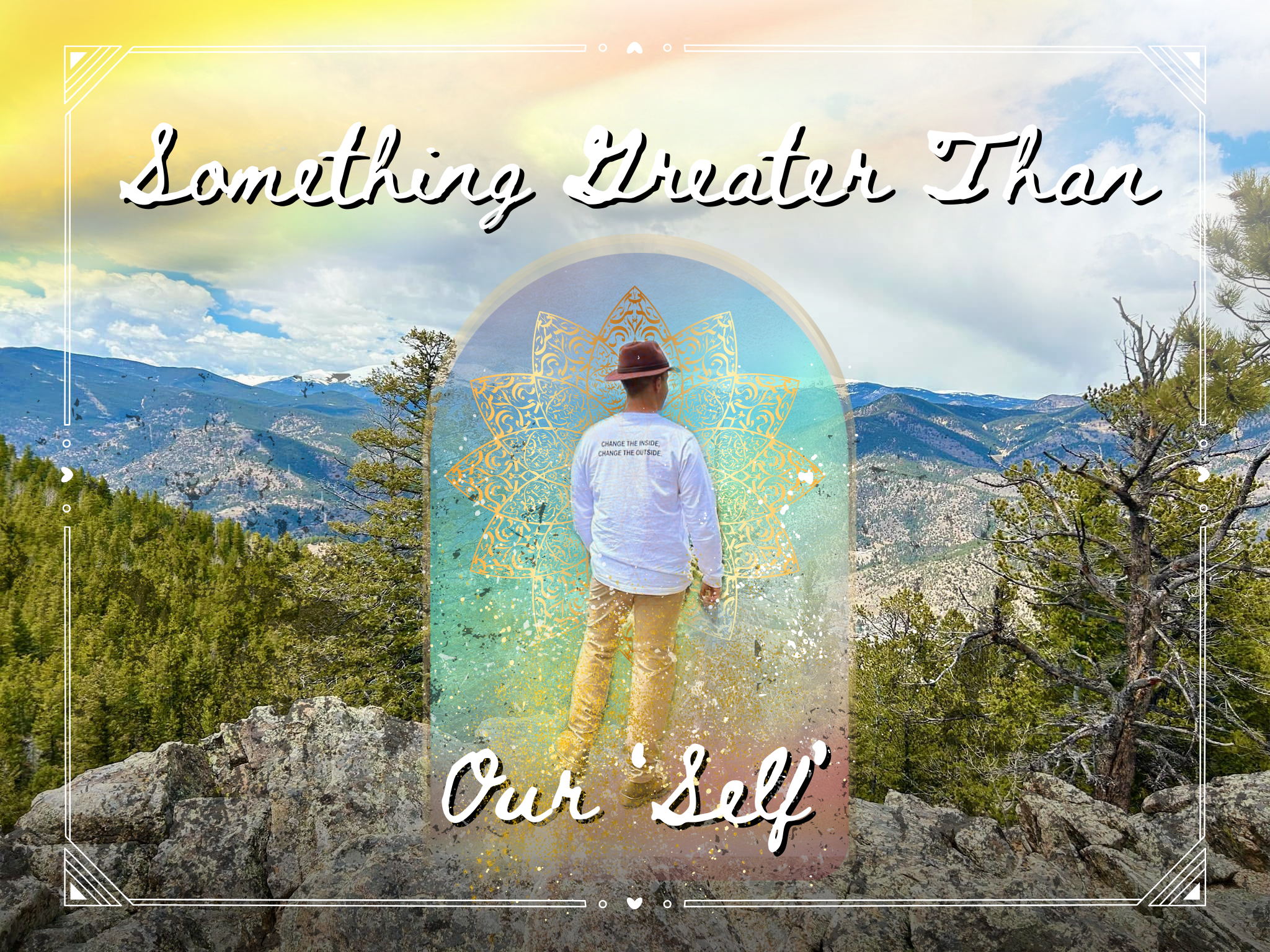
Something Greater Than Our ‘Self’
Part 1:
We have resisted it for so long. We have successfully circumvented, dodged, and squirmed around the subject, but the time has come. Introspection, self-awareness, and knowledge that leads to understanding can, of course, bring a more tranquil and contented existence—but how motivating is it to pursue such things for yourself?
People know that exercise is good for them, yet how many of us commit to the kind of exercise that leads to the fitness we’re capable of? So it is with the nature of the mind, except we are not merely aiming to prolong our own lives or lead individuals to psychological well-being. Just as neglecting personal fitness harms the health of the body, neglecting our collective concepts and ideas has consequences for the larger organism of humanity.
As the Walking America Couple, we have the fruits of the world in view, along with the roots and soil that feed this malnourished organism. Together, we must ask ourselves: What are its roots, and what nourishment is truly sustaining? If we don’t begin consuming the proper ideas, and exercising the most beneficial perspectives, we will suffer and die like every other organism which sits idle, failing to maintain a wholesome diet.
It has been a secular journey so far. If you peruse our writings, you will find the meat that holds it together, but it still lacks the bones to stand tall and the spirit which animates. Without its true foundations to support it or the life to drive it forward, it remains incomplete—beneficial, but hardly transfiguring; interesting, but inert. Try as we might, this life-giving force is not something we can instill. Only One can breathe into the material the breath of life, lending it strength and purpose.
This does not mean our imposition of religion, dogma, or doctrine—certainly not in the sense of pointing anyone toward some inerrant ideology—but rather the introduction of the most empowering source of love: a love that dismantles pride, prejudice, and preconception—a love that erodes judgment and leads with compassion. More than ever, we hope to dismantle those barriers, but to accomplish our aims, this course is unavoidable. It is God who bridges the largest chasms impeding true selflessness.
If all we are is the self, why should we care about others as much as our “self”? When faced with loss, and the need to take from others or have less for ourselves, what compels us to choose charity over greed? When faced with death, and the demand to harm another or be harmed ourselves, what compels us to choose right action if the outcome is the end of experience altogether? Without the divine, true selflessness becomes fragile—a feigned priority acted out at our convenience, though never fully embraced or felt. We are capable of far more when we live in service of something greater—a life better lived, actions better acted, and a self more selfless.
For those of you who have been with us for some time, we hope we’ve earned enough of your trust that, even if the destination feels uncertain, you can have confidence in the direction and faith in our intentions. This has been a long time coming, and there is far more ahead. Some of it may take you by surprise, but we hope you will stay with us as we continue to embrace life’s deepest, most meaningful pursuits. We love you all. Let’s walk this road together—it’s narrower than most might imagine, yet the journey has only just begun.
Part 2:
God is not so simple as to be accurately portrayed by the concepts of our mind. To quote C.S. Lewis: “Thoughts are like coins; let me not worship them instead of Thee, nor worship Thee in them instead of Thee.” Our intellectual constructs are insufficient to grasp the full essence of the divine, as they are confined by the limits of human thought. The Tao Te Ching goes so far as to open with this sentiment stating, “The name that can be named is not the eternal name.”
God is not so tangible as to be falsified within the parameters of the scientific method. As Thomas Aquinas states, “We cannot know what God is, only what He is not. We must therefore consider the ways in which God does not exist, rather than the ways in which He does.” God’s nature exceeds empirical observation, and thus cannot be pinned down by the tools of science, which are limited to the material world. The Upanishads tackle this paradox when they say, “It [God] is distinct from the known and It is beyond the unknown,” later adding, “He who thinks he knows It not, knows It. He who thinks he knows It, knows It not. The true knowers think they can never fully know It, while the ignorant think they know It.
Yet, God is not so distant as to be beyond our reach. Paul says to the men of Athens, “The God who made the world and everything that is in it…does not dwell in temples made by hands; nor is He served by human hands, as though He needed anything, since He Himself gives to all people life and breath and all things; and He made from one every nation of mankind to…seek God, if perhaps they might feel around for Him and find Him, though He is not far from each one of us; for in Him we live and move and exist.”
But if God is found neither in thought nor in data, how can we ever come to find them? Experience. And how do we experience God? “We” do not. Instead, God steps forward when we step back—when we cease clinging to ego and touch true selflessness. God shines through when our darkness fades. Meister Eckhart writes, “The eye through which I see God is the same eye through which God sees me; my eye and God’s eye are one eye, one seeing, one knowing, one love.”
The self, however, is an impediment to experiencing this reality. The “self,” as we are referring to it, or “ego,” is the construct of our identity—woven together from memories, emotions, desires, and beliefs that define our sense of personhood. It is the mental and emotional framework through which we perceive and interact with the world. Despite its seemingly static nature it is transient—bound by matter and time. There is both logical and scientific evidence for this, but we will explore the self in greater detail at another time.
What is important to note now is that this veil dissipates not by force, but by surrender, by making room for the divine presence—a presence only experienced in unadulterated presence: a conscious space absent desire and attachment.
In this way, divine understanding is not something we can force or achieve through intellect, but something that emerges when we stop trying to master it and allow it to unfold in the silence of selflessness.
Part 3:
What are you, what’s the self, and what’s that got to do with God?
This one’s going to be a bit of a technical slog, but it's foundational, and it’s making its way somewhere deeper.
On September 13, 1848, Phineas Gage, a railroad foreman, survived an explosion in which a tamping rod blasted through his left frontal lobe. To everyone’s surprise, Gage lived. He sustained no motor or speech impairments, and his memory remained intact. However, Gage’s personality is said to have changed, causing his colleagues to state that he was “no longer Gage.” Gage was described as restless, disrespectful, and unreliable afterward—unlike his former self. This was just the beginning of what we’ve come to learn about the mind and its relationship to our person—our self.
In the years that followed, advances in contemporary neuroscience and clinical psychology have revealed much about the brain’s role in shaping who we are. Just as Gage’s case showed us how the frontal lobe plays a crucial role in our behavior, impulsivity, and decision-making, split-brain patients (whose hemispheres are severed from one another) have shown that the brain’s two sides can operate semi-independently. The left hemisphere typically governs speech and language, while the right specializes in nonverbal tasks like visual-spatial processing and facial recognition. “The split work really showed that the two hemispheres are both very competent at most things, but provide us with two different snapshots of the world,” says Richard Ivry, director of the Institute of Cognitive and Brain Sciences at the University of California, Berkeley.
Over the course of this article and those to follow, we will see that, from whatever angle we examine it, if we evaluate the evidence objectively, it becomes clear that we are altered according to the alterations in our brain—and that the true nature of the self is not the “unified self” we experience, but rather an illusion which occurs at the intersection of many distinct processes, systems, and mechanisms. Let’s dive deeper:
Many neurological conditions challenge our sense of identity and self. Alzheimer’s disease, for example, erodes memory and recognition, sometimes preventing individuals from recognizing their own reflection. Similarly, Dissociative Identity Disorder, often stemming from some environmental catalyzer such as severe trauma, creates multiple distinct identities within one person.
Deep brain stimulation, used to treat movement disorders like Parkinson’s, can also trigger unexpected personality changes. Several case studies show that DBS might influence some patients to such an extent that it disrupts their experience of psychological continuity—of persisting through time as the same person.
Our brain’s adaptability, neuroplasticity, also demonstrates how malleable the self can be. Experiences literally restructure our neural connections, and therapies like cognitive behavioral therapy rewire thought patterns, both mentally and physically—neurologically.
Behaviorism has shown the real-world implications of neuroplasticity, specifically how external stimuli and reinforcement shape behaviors, beliefs, and even identity. From Pavlov’s experiments to Skinner’s work on operant conditioning, we see that much of what we consider our “self” is a collection of learned responses, conditioned through interaction with our environment. In extreme cases, like the systematic indoctrination seen in North Korea, entire identities are conditioned. Nearly all expressions of personhood, not only behaviors but beliefs, have been sculpted by the state. This brings up some serious questions about the extent to which any of us truly “choose” our beliefs or actions. How much of “who we are” is simply the sum of our conditioning and biology?
As briefly touched on, traumatic experiences also shape our brain and sense of self. It is well documented that the amygdala governs fear and emotional regulation, and can become enlarged from psychological trauma, such as PTSD. Practices like meditation, however, can shrink this portion of the brain—effectively regulating our fear response—while strengthening connections in the prefrontal cortex, which governs decision-making and self-regulation. Reading on the other hand can grow white matter and restructure narrative thought patterns. But let’s bite down on meditation for a moment—we can consider it one of the most important pieces to this puzzle.
Meditation offers a way to disrupt the conditioned thought patterns that behaviorism underscores. Through meditation we aim to observe our thoughts and emotions without becoming attached to them, often by focusing on a sensation of little stimulation such as the breath. This is where it gets interesting. Among the other impacts it has on our brain, meditation dampens activity in the default mode network (DMN), a set of brain regions linked to self-referential thinking.
By dampening DMN activity, meditation can dissolve the sense of a unified, stable self, leading to ego dissolution—the death of the self. Though total ego dissolution does not persist outside intensive meditation, practiced meditators often report greater compassion, a sense of interconnectedness, and a reduced burden of ego and identity in their everyday lives.
While science can point to the reality of self, it all feels very distant. We can understand something logically, yet never know that reality ourselves. It doesn’t matter how much a color blind person reads about the electromagnetic spectrum, the human eye, and how these two result in the experience of color. It will not result in the experience of seeing color. Meditation, however, is our means of experiencing the transience of self for ourselves. Until we experience it, they’re just words.
But having experienced it or not, the self is not fixed. It is a construct shaped by biology, experience, and environment—and it can be modified and downregulated to greater or lesser degrees through the manipulation of these elements and introspective practices, such as meditation.
However, this raises profound questions about our relationship to God. If the self changes over time and it’s determined by the brain and conditioning, what does it mean for our eternal identity? Or does death mean the cessation of experience altogether? Is the soul somehow separate from our ever-changing self? If so, what part of us continues after death? Is it the person we are at the moment of death, or the sum of our experiences? What about infants and toddlers who pass away before they have a sense of identity? Should we believe we exit this life as some perfectly realized version of ourselves?
And if external factors beyond our control—such as genetics or the country/group we are born in—shape the self, can we really claim to have free will in our spiritual journey? If God judges us based on our beliefs, how does divine judgment reconcile with the reality that behaviors and beliefs are conditioned by experiences, environments, and brain changes that are often outside of our control?
Beyond any of that, why is selflessness so highly esteemed by the human race across cultures, and how do God and love fit into all of this?
There is still far more foundation to be laid, but I believe any consistent worldview should attempt to reconcile these concerns. Though I don’t have all the answers, I’ll give you what I’ve got over the coming weeks.
Part 4:
Let’s do it again! This time from a different angle!
What are you? What’s the self? And what’s that got to do with God?
Imagine a ship which sails around the world. Over time, it is gradually repaired until every single plank of the original ship has been replaced. Is the fully repaired ship still the same ship as the original? If it isn’t, at what point did it become a new ship? You can also imagine that all the old planks are gathered and reassembled exactly where they were in the original ship. Is this reassembled ship the original ship? This is known as Theseus’s ship, a paradox which has perplexed philosophers for thousands of years, and it has huge implications for identity and our sense of self.
Just like the Ship of Theseus, where each plank is replaced over time, our bodies undergo constant change at the cellular level. In fact, cells in the human body are continually being replaced, including brain cells. Within 7 to 10 years, not one cell you have now will remain.
The concept of neuroplasticity, which we touched on last time, further complicates the idea of identity. The brain forms new neural pathways in response to learning, experience, injury, and disease. This means that, even as cells die and are replaced, the brain’s overall structure and function evolves over time, and our selfhood also changes in response to this.
Memory and perception may hold our sense of self together through this constant change, but even these are not stable. Memories change over time, and it’s not simply embellishment that causes that fish the fisherman caught to grow a couple of inches every year. Likewise, love and hate alter our sense of perception, and this is why the people we fall in and out of love with can appear to grow more or less attractive.
You might be saying to yourself, “But I always feel like me. Isn’t that simply what makes me myself?” Carl Jung, who some might call the father of contemporary psychology, stated, “The persona is that which in reality one is not, but which oneself as well as others think one is.” Let’s take a deeper look, and see what it’s really like to be you.
David Hume, one of the English language’s most noteworthy philosophers writes, “For my part, when I enter most intimately into what I call myself, I always stumble on some particular perception or other, of heat or cold, light or shade, love or hatred, pain or pleasure. I never can catch myself at any time without a perception, and never can observe any thing but the perception…something simple and continu'd…I am certain there is no such principle in me.”
Hume acknowledged that memory gives us a sense of personal identity over time, but maintained that this continuity is merely a construct and not evidence of an actual, unchanging self. Instead, he argued that the self is nothing more than a bundle of perceptions—a collection of sensory experiences, emotions, thoughts, and memories that constantly change over time.
Western philosophy is not the only school of thought to reach this conclusion. Long before Hume, Gautama Buddha (563-483 BCE) taught something very similar—Anatta, the no-self teaching. Buddha taught that what we call the self is merely an illusion—a temporary aggregation of physical and mental processes. Just as the planks of Theseus’s Ship are replaced over time, the body and mind are constantly changing, leaving no unchanging core. But he also went a step further. According to Buddha, clinging to the idea of a permanent self is a source of suffering, and liberation comes from understanding that the self is as impermanent as any other phenomenon. Still though, how can we be sure this isn’t just a bunch of sophistry?
You don’t need to take anyone’s word for it. In silence and stillness, with observation and introspection, this becomes apparent. Though we often identify as our thoughts, thoughts arise spontaneously—they appear out of nowhere—and they are notoriously difficult to hang onto. That’s why we take notes and keep journals. Everything which arises in consciousness, soon fades away beneath the next object of our awareness.
The formation of our thoughts begins first from stimuli processed through our sense organs, which gather information from our environment. This sensory input is then interpreted and shaped by our genetic predispositions, which influence how we perceive, prioritize, and respond to the world around us. Our thoughts are not simply self-generated but emerge from an intricate interplay between external influences and our biology.
Thus, the things you expose yourself to play a tremendous role in shaping your thoughts and the person you become. Imagine what your inner experience would be like if you had never learned a language, never learned to read, or had no exposure to TV or music. This truth operates not only on a large, life-defining scale but also on a smaller, day-to-day level—both macroscopically and microscopically. The thoughts you think throughout your day will be subtly influenced by whether you start the morning reading a book or watching TV—by whether you exercise and eat nutritious plant-based foods or slam a plate of syrupy pancakes. Every aspect of your environment shapes you in the short term, and over time, these influences accumulate to shape you in the long term.
“Yeah, yeah,” I hear you say, “What’s this got to do with God?”
It has everything to do with God. We’re almost there. More next time.
Part 5:
Over the past few articles, we’ve explored the deceptive nature of the self—how, despite feeling static and constant, this perception is merely an illusion—and considered how we might deduce this for ourselves. In reality, the self is highly malleable, capable of being altered by factors such as surgery, brain damage, psychological trauma, environmental influences, and self-regulation. Now we turn our attention to its spiritual correlates.
Whether consciously or not, nearly all religions have recognized and harnessed the self’s malleability to draw closer to God, elevating self-regulation and the prioritization of selflessness to the highest virtues.
Beginning with Christianity, Jesus teaches that seeking God does not mean self-preservation but service and selflessness.
“If anyone desires to come after Me, let him deny himself… For whoever desires to save his life will lose it; but whoever loses his life for My sake will find it.” – Matthew 16:24-25
And how do we serve selflessly? Jesus implores his followers to become childlike—returning to a state unburdened by ego and free from the conditioned concepts and identities that divide us.
“Unless you change and become like children, you will not enter the kingdom of heaven.” – Matthew 18:3
It is only through this transformation, a reshaping of our ‘selves’ into something simpler and humbler, that we are able to “Stop judging…” (Matthew 7:1) and “Love [our] neighbor as [our]self.” (Mark 12:30).
Jesus himself set the highest example of selflessness, not only in his display of indiscriminate acceptance, such as the parable of the Good Samaritan, his compassionate treatment of the woman at the well, and the sinful woman with the alabaster jar of perfume but ultimately through the complete surrender of self in his death on the cross.
Yet, his aim wasn’t simply to pave a path to pearly gates and golden roads. What did he say? “This is My commandment, that you love one another as I have loved you. Greater love has no one than this, that he lay down his life for his friends.” – John 15:12-13
However, self-regulation and selflessness are not cornerstones of Christianity alone; they are central to nearly every major world religion. In Islam, the self (nafs) is seen as something that must be disciplined and refined to align with the will of God, whereas selflessness (al-ithar) is considered a most noble quality. Through self-regulation, fasting during Ramadan, and acts of charity (zakat), Muslims cultivate selflessness and humility, focusing on submission to the divine will rather than the fleeting desires of the ego.
The Qur’an says, “Be mindful of [God] to the best of your ability… and spend in charity—that will be best for you. And whoever is saved from the selfishness of their own souls, it is they who will attain a happy state.” —Surah At-Taghabun, Ayah 16
Even the Golden Rule—a reflection of properly regulated selfhood—appears in Hadith 13: “None of you will believe until you love for your brother what you love for yourself.”
Shifting our attention eastward, we still find that curtailing self and the attainment of selflessness are our means of living in harmony with the divine. Taoism emphasizes the dissolution of self in a way much akin to becoming childlike—that of the empty vessel and that of uncarved wood.
If we are to live in harmony with the divine, chapter 19 of the Tao Te Ching tells us we must, “Embrace the simplicity of the unhewn log; lessen selfishness, [and] diminish desires…”
And chapter 11 more poetically states, “We join spokes together in a wheel, but it is the center hole that makes the wheel useful. We shape clay into a vessel, but it is the emptiness inside that makes the vessel useful. We hammer wood for a house, but it is the inner space that makes the house livable. We work with being, but non-being is what we use.”
In Hinduism, the individual self, known as Jiva, is likewise understood to be temporary. To know God requires understanding the true nature of the self, and the Jiva serves as an impediment to this understanding. Followers draw closer to God by recognizing the Jiva while surrendering to the divine. This surrender often takes the form of karma yoga—the practice of selfless action, where the results of one’s actions are offered as a spiritual act, rather than hoarded or credited to oneself.
Emphasizing the need to cultivate a more loving self, chapter 12 of the Bhagavad Gita states, “He who hates no creature, who is friendly and compassionate, who is free from attachment and egoism, balanced in pleasure and pain, and forgiving, ever content, steady in meditation, self-controlled, and possessed of firm conviction, with mind and intellect dedicated to Me—he, My devotee, is dear to Me.”
In the last couple of articles, we explored the nature of the self through secular lenses—scientific, psychological, and philosophical. You might be wondering why such groundwork was necessary, if God already emphasizes the importance of selflessness across religions. The answer lies in understanding where all these perspectives converge, and Buddhism addresses this with striking clarity.
The 14th Dalai Lama explains, “With regard to selflessness, it is necessary to know what ‘self’ is—to identify the self that does not exist. Then one can understand its opposite, selflessness. Selflessness is not a case of something that existed in the past becoming non-existent; rather, this sort of ‘self’ is something that never did exist. What is needed is to identify as non-existent something that always was nonexistent, for due to not having made such identification, we are drawn into the afflictive emotions of desire and hatred as well as all the problems these bring.”
“Yeah, okay, the self’s bad and it’s an illusion n’ stuff. But… I still feel like a self.”
“Lol. Yes, padawan. Don’t we all?” In the coming articles, we’ll delve deeper into the practices that can lead one to experience true selflessness and uncover more about those who may have glimpsed what lies beyond the illusion.
In the silence of selflessness—I AM. “Be still, stop striving, let go, and know that I am God,” saith the Lord.
Part 6:
So far, we have explored God as something beyond our conceptual grasp, the malleable and illusory nature of the self that attempts to conceptualize God, and the prioritization of selflessness across religious traditions. Now, we arrive at a pivotal moment.
Moving forward, we’ll examine how the dissolution of the self—an experience devoid of personhood and conceptualizing—has given rise to the world’s major religions. This recurring motif, where the self surrenders to a greater reality, lies at the heart of the enlightenment narratives found in nearly every major spiritual tradition.
Practices such as fasting, meditation, and social isolation—each of which dampens activity in the Default Mode Network (the primary system in our brain responsible for our sense of self)—serve as catalysts for many founders’ spiritual journeys and divine enlightenment.
The Default Mode Network (DMN) acts as a regulatory hub in the brain, overseeing self-referential thinking, daydreaming, and many conceptual frameworks, including our concepts of past and future. It is the network responsible for constructing narratives about ourselves and projecting them across time. When the DMN quiets down—such as during fasting, meditation, or other altered states of consciousness—MRI scans show increased connectivity between regions of the brain that don’t typically communicate as actively. This downregulation allows for new neural pathways to emerge, facilitating non-ordinary states of awareness. While the full implications of these changes are not yet fully understood, they suggest that reducing DMN activity enables the brain to operate in a more integrated and expansive way.
•Fasting reduces activity in the Default Mode Network (DMN), including the medial prefrontal cortex (a core region of the DMN), which is heavily involved in self-referential thinking. This reduction in DMN activity can diminish habitual introspection and self-focused thought patterns, potentially shifting attention toward a broader and less egocentric perspective. Additionally, fasting alters the brain’s energy metabolism, promoting neurochemical changes that can enhance mental clarity and focus.
•Social isolation reduces external stimuli that engage the DMN in self-referential and social cognition, allowing the mind to redirect cognitive bandwidth and adapt to the absence of interpersonal interaction, creating heightened awareness.
•Meditation reduces self-referential thinking by directly decreasing DMN activity, particularly in mindfulness and non-dual practices that emphasize present-moment awareness and minimize conceptual frameworks.
These practices strip away the mental chatter and self-referential thinking that underpin our sense of self, creating fertile ground for the perception of a reality beyond the individual. To avoid being reductive, it’s important to mention that while the Default Mode Network plays a role, spiritual experiences arise from shifts across multiple regions of the brain and neural processes. There’s a lot to dig into here, but I’m going to leave it at this level of detail and welcome you to research this further for yourself.
From a materialist worldview, one might argue that spiritual experiences are thus hallucinations caused by abnormal brain function—that, of course, people see and believe all kinds of things when their brain isn’t functioning normally. However, unlike random hallucinations, spiritual experiences share certain consistent features: they evoke feelings of unity, love, and instill insights which supersede conventional wisdom, often leading to lasting psychological changes, such as increased altruism, greater life satisfaction, and reduced fear of death.
Furthermore, neuroscience shows these experiences stem from coordinated shifts in brain activity, like downregulating the Default Mode Network, rather than chaotic dysfunction. This suggests they are not mere errors, but integral to the human experience and self-transcendence.
Many believe that if science can explain how something works, it has stripped it of its miraculous properties. Dismissing these as hallucinations, however, assumes subjective experiences lack validity just because they’re biologically mediated, yet all perceptions, whether external or internal, are brain-produced. If these experiences have consistent, transformative effects, they may be a natural—if not normal—part of human consciousness, though we have stepped away from them in this age of abundance, viewing them as abnormalities rather than a feature of the human experience.
Therefore, it is the opinion of this humble consciousness that what we are looking at, in this bizarre realm of egoity and desire, is a historical motif and universal paradigm: the dissolution of our ‘self’ is our path to truly know something greater than our ‘selves’ and align our will with what practitioners across traditions have described as a greater reality.
By examining key examples from Judaism, Christianity, Islam, Buddhism, Hinduism, and other traditions, we can argue inductively that the dissolution of self is not merely a cornerstone of religion but a universal element of spiritual enlightenment and transformation.
Next time, we’ll explore the roots of the world’s religions and see how those who experienced the dissolution of self gave birth to the spiritual traditions we know today.
Part 7:
When people ask us what we believe, we often pause—not because we don’t know, but because explaining it feels like walking into a maze of information too deep to reach the other side within the course of a single conversation. But if time allows, this is how I usually go about it: Any religion that claims its god is just must grapple with a difficult question—what happens to those who, through no fault of their own, were born in the wrong place or at the wrong time to adopt the “correct” beliefs? Would God truly discriminate based on geography and birthdate? Many modern interpretations bend under the weight of contemporary moral expectations, offering explanations that can often feel like afterthoughts—typically in the form of ad hoc hypotheses—while certain scriptures within the faith remain strikingly unyielding.
Consider these words:
“Salvation is found in no one else, for there is no other name under heaven given to mankind by which we must be saved.” —Acts 4:12
“I am the way and the truth and the life. No one comes to the Father except through me.” —John 14:6
“Whoever believes and is baptized will be saved, but whoever does not believe will be condemned.” —Mark 16:16
“Whoever believes in him is not condemned, but whoever does not believe stands condemned already because they have not believed in the name of God’s one and only Son.” —John 3:18
“Whoever has the Son has life; whoever does not have the Son of God does not have life.” —1 John 5:12
These statements and those of many other faiths leave little room for interpretation and raise a troubling question: If a perfect and omniscient being knew humanity would turn to such texts for evidence of justice and perfection using their god-given rationality, why allow any ambiguity to persist over such a serious concern? Why not provide a clear solution that could resonate with all of humanity, regardless of time or place?
Perhaps the answer lies not in doctrine, dogma, or an allegedly inerrant text, but in something universal—something that can be uncovered within each of us. This is the crux of this series. When we look to the founders of most spiritual traditions, we find a compelling similarity: they engaged in practices that dissolve the very thing that creates dogma, separating us from one another and even God—the self. Withdrawing from the world, they often fasted and meditated in solitude, seeking truths beyond the conventions of their time. They returned transformed, offering penetrating insights and a new understanding of the divine.
What follows is a closer look at these stories and the experiences of these individuals. By exploring their journeys, we may find a thread that connects the divine to something innate within us all. We might even uncover the tools to weave that thread into the tapestry of our lives.
Quick caveat: Verifying the historical truth within these stories is a deep and fascinating pursuit, but it breaches the core focus and scope of this series. For the purposes of this article, I will be focusing on the traditional view through the lens of each faith.
Moses, raised by the daughter of Pharaoh, had access to immense privilege. Yet, outraged by the injustice of slavery, he denied himself this life and fled after striking an Egyptian. Sometime later, while pasturing sheep in the isolation of the wilderness, God appears to him in the form of a burning bush and tells him his name—I AM. After the Exodus, Moses isolates atop Mount Sinai, fasting for 40 days and nights. There, he receives the Ten Commandments and revolutionizes his and future societies.
Moses is not the only Old Testament figure whose social isolation and fasting led to divine revelation. Elijah likewise flees to the wilderness, where an angel feeds him under a broom tree—food he too fasts on for 40 days and nights before reaching a cave, where he hears God in a “still small voice,” or “whisper.”
Of course, most are familiar with the story of Jesus. He spent yet another 40 days and nights fasting in the wilderness, where he was tempted by Satan—the accuser—who, among other things, offered him all the kingdoms of the world—something necessarily denied if one wishes to align their will with the divine. Thereafter he committed his life to his ministry, working to elevate love and erode many of the barriers that society placed between those of different demographics and status.
Several hundred years before Jesus, Siddhartha Gautama (563–483 BCE), the Buddha, was born a sheltered prince, living in opulence and shielded from the outside world by his father, who hoped to keep him ignorant of suffering. On a rare journey beyond the palace walls, he encountered the Four Sights: an old man, a sick man, a corpse, and a renunciate of worldly things, serene in the face of these hardships.
Haunted by these sights, Siddhartha abandoned his royal life and set out in search of liberation. For six years, he practiced extreme asceticism, denying himself food, comfort, and rest. Yet, this path left him emaciated and near death, without the answers he sought. Thus, he resolved to sit beneath the Bodhi Tree and meditate until he found the truth. There, he faced Mara, the Tempter, a personification of fear, desire, and ego. Mara’s temptations came as visions: beautiful maidens to seduce him, armies of demons to terrify him, and whispers of doubt to undermine him. But Siddhartha remained unmoved, recognizing Mara’s power as an illusion born from the self. As dawn broke, he achieved Nirvana, seeing clearly the impermanence of all things (Anicca), the suffering caused by attachment (Dukkha), and the absence of a fixed self (Anatta). Freed from ego and illusion, he became the Buddha and dedicated his life to guiding others toward liberation.
Muhammad was likewise inspired by the troubled world around him. Disheartened by the moral corruption, inequality, and idolatry of his society, he often sought solitude in the Cave of Hira, a small mountain retreat outside Mecca. There, he would meditate and reflect in isolation. Many believe Muhammad spent as long as 30 days meditating there, particularly during the month of Ramadan. During one such retreat, the Angel Gabriel (Jibreel) appeared before him, commanding him to “Recite.” Initially unsure and frightened, Muhammad eventually recited the first verses of the Quran, marking the beginning of his prophetic mission.
The dissolution of the self is central to Taoism also, often described as returning to a natural state of being, free from artificial constraints and social conventions. Laozi (Lao Tzu), the central figure of Taoism, was said to be a scholar and official during the Zhou Dynasty. Disillusioned with the moral corruption of society, he withdrew to the wilderness in search of peace and clarity. After some time in isolation, he was met by a guard at the western gate of the empire who asked him to record his wisdom, which led to the creation of the Tao Te Ching.
This text outlines the Tao, the underlying principle of the universe, and teaches that true harmony with the Tao requires letting go of attachment and selfhood. Laozi’s concept of wu wei (effortless action) emphasizes living simply, yielding, and accepting the impermanence of existence. His teachings suggest that transcending the self involves not forceful control but flowing with the natural order.
In Hinduism, the dissolution of the self is equally important, with practices of meditation, isolation, and renunciation seen as essential steps toward self-realization and union with the divine. Dattatreya, a revered figure in Hinduism, renounced his familial life at a young age, embarking on a life of asceticism while seeking spiritual enlightenment in solitude. His journey highlights the dissolution of the self through detachment from worldly desires.
Similarly, the rishis of the Vedic period sought truth through intense meditation and seclusion, retreating from society to direct their focus inward. And Ramana Maharshi, a more modern example, experienced a profound awakening at the age of 16, prompting him to retreat to the mountain of Arunachala. There, he lived in caves for years, practicing self-inquiry with the question “Who am I?” to dissolve the illusion of the self and attain liberation.
Hinduism even outlines several stages of life. The later two, Vanaprastha and Sannyasa, intensively aim to bring about divine connection through the dissolution of the self. In Vanaprastha, individuals retire from active family life to live in isolation, preparing for Sannyasa, where they renounce all worldly attachments to meditate and seek divine oneness in their final years.
These barely begin to skim the surface of the ways spiritual traditions have been shaped by the dissolution of self via fasting, meditating, and isolation. Just to hit a few more:
•In Jainism Mahavira renounced his royal life and worldly possessions to embrace asceticism, spent 12 years in deep meditation and fasting, practicing nonviolence and detachment, and is said to have achieved Kevala Gyana (enlightenment) after fasting continuously for two and half days under the sun without water.
•In Sikhism Guru Nanak spent several days in meditation by a river, during which he “disappeared” and had a divine experience of unity with God. He then traveled extensively for years, engaging in reflective dialogue and meditation to dissolve the ego and understand the divine oneness (Ik Onkar). His teachings also stress humility, surrender, and the eradication of ego (haumai) as paths to divine insight.
•And of course, there are many different indigenous traditions which often go unrecognized, but similarly undergo rites of passage involving fasting, solitude, and intense meditation in sacred natural spaces, such as some Native American tribes which would engage in vision quests, involving fasting and solitude to seek spiritual guidance.
Okay, so let’s say ego dissolution (the dissolution of self) really is core to spiritual revelation. What about all these different, mutually exclusive religions? What about, “No one comes to the Father except through me”? And what exactly are these people experiencing, if it gives rise to all different manner of ideas? Who’s to say that’s God? Are you sure you’re not just creating more problems than you’re solving? Or is there some way to reconcile these potential disparities, unifying those of different doctrinal traditions with the prioritization and pursuit of selfless love?
Guess you’ll have to keep reading!
Part 8:
What if the greatest barrier between us and God truly is the very thing we believe defines us: the self? Building from the information we’ve already explored, let’s say this is the case and that these figures might have actually glimpsed some aspect of a greater reality. Why, then, do they all emerge with such different ideas about the divine?
Because the divine exists beyond form, any attempt to describe it is inevitably flawed. Language and concepts, being finite, cannot contain or communicate something beyond the perceptual forms they have been created to describe. When people try to explain their encounters with the divine, they must resort to metaphors, analogies, and symbols rooted in their culture and personal experience. What emerges is not the thing itself, but a fragmented, distorted reflection. It’s like trying to describe color to someone who has never seen—an approximation at best, hopelessly inadequate at worst.
Yet this isn’t the only challenge. The self—the very thing these figures sought to transcend—remains a filter through which the experience must pass. The self imposes its emotions, concepts, biases, and desires onto the divine, distorting it further. Those who are unaware of this danger are the most prone to misrepresentation. In their eagerness to make sense of the experience, they might anthropomorphize the divine, attributing human traits like will or judgment to something that exists beyond personhood. They might project their own values onto it, condemning others or behaviors they find unsettling as unnatural or ungodly, when in truth, these judgments originate not from the divine but from ego.
This still is just the beginning of the narrative’s evolution. Once the story leaves the individual, it passes through the minds and lips of others, each adding their interpretations, extrapolations, and interpolations. The telephone game continues: one self informs another, each distorting the story further through their own misconceptions, miscommunications, biases, desires, and attachments. Over time, what began as a fleeting moment of contact with something greater evolves into a doctrine or system that reflects more of systemic ego than divine reality. A seed of truth remains, but it becomes buried beneath layers, obfuscated by these confounding influences.
How do we know this isn’t all just speculative poppycock? Tomorrow we’ll take a look at some real world examples!
Part 9:
As we discussed yesterday, religious traditions are ever evolving entities, shaped by centuries of psychological, cultural, historical, and theological factors. This evolution is not unique to any one faith but can be observed across traditions.
Our exploration is not about questioning the validity of these traditions—we have great admiration and appreciation for each of them—but about understanding how they have adapted and grown so that we may reach the deeper truths underlying each. By examining how these figures were portrayed in early texts compared to later interpretations, we can see a shared human tendency to elevate spiritual figures over time, blending history with myth as people seek to make sense of, interpret, and relay one figure’s initial experiences and resulting teachings. We hope not to alienate anyone here but to inspire both believers and seekers to engage thoughtfully with their faith while appreciating the rich tapestry of human spirituality. Without further ado…
•The Pali Canon (5th–3rd Century BCE), the earliest Buddhist texts, primarily records the Buddha’s teachings and portrays him as a wise teacher who achieved enlightenment through meditation and insight. While it includes some miraculous elements, such as the Buddha’s ability to read minds or calm storms, these are generally subdued and used symbolically rather than to emphasize supernatural power.
By the 1st Century CE, texts such as the Lalitavistara Sutra and other Mahayana scriptures introduced more elaborate miraculous accounts. These include Siddhartha taking seven steps at birth, speaking as an infant, and declaring his future enlightenment. Similarly, depictions of his enlightenment began featuring radiant light encircling his head—a motif later mirrored in early Christian art of Jesus. These additions align with Mahayana Buddhism’s theological shift, which presents the Buddha as a cosmic figure transcending human limitations.
Between the 1st–6th Century CE, particularly in Mahayana traditions, the Buddha came to be portrayed as an embodiment of ultimate reality (Dharmakaya). Stories expanded his miracles and divine attributes to inspire devotion and elevate his status. For instance, the Battle with Mara—initially a symbolic narrative of overcoming ego in the Pali Canon—evolved into a dramatized cosmic struggle in later texts, with Mara personified as the king of demons. This transformation reflects both mythological elaboration and Mahayana Buddhism’s devotional emphasis.
•In Islam, the Qur’an (revealed between 610–632 CE) portrays Muhammad as a human prophet and the final messenger of God, emphasizing his mortality and rejecting divine attributes or powers (Surah 18:110: “I am only a man like you”). It presents his primary miracle as the Qur’an itself, seen as a divine revelation surpassing human capability in its eloquence and guidance.
Early biographical accounts, such as Ibn Ishaq’s Sira (compiled 760 CE, though surviving in later redactions), focus on Muhammad’s role as a reformer, lawgiver, and unifier of Arabian tribes. However, later traditions expand on miraculous narratives. By the 8th–9th Century CE, the Hadith collections record events like the splitting of the moon and the Isra and Mi’raj (the Night Journey), in which Muhammad is said to ascend to the heavens, meet past prophets, and witness divine mysteries. These expand on otherwise ambiguous verses in the Quran, serving theological and devotional purposes but appearing decades or even centuries after Muhammad’s lifetime.
From the 9th to 12th Century CE, some Sufi traditions began to portray Muhammad as a cosmic figure, describing him as the “Perfect Man” (al-Insan al-Kamil) and as containing the primordial light of creation (Nur Muhammadi). Miracles attributed to him expanded in number and significance, becoming central to Islamic spirituality and devotion.
•Laozi is traditionally credited with writing the Tao Te Ching, and these are our earliest records of such a person’s existence (6th–4th Century BCE). However the text itself focuses on the Tao as the ultimate, ineffable reality and mentions little, if not nothing, about Laozi’s personal life.
Historical records, like the Shiji (1st century BCE) by Sima Qian, describe him as a wise philosopher who retreated into the wilderness. There is no evidence of supernatural events in the earliest accounts. Again we see the introduction of miraculous narratives (2nd Century CE), and Laozi begins to be mythologized as a deity embodying the Tao. Stories claim his mother carried him in her womb for 81 years, resulting in his birth as an old man. Taoist religious texts like the Zhuangzi (though not directly about Laozi) helped elevate him as a semi-mythical sage who transcended ordinary human limitations.
By the 2nd–6th Century CE, during the formation of Taoism as an organized religion, Laozi became worshipped as the “Supreme Venerable Sovereign” (Taishang Laojun), with temples, rituals, and festivals reinforcing his divine status.
•Of course, this same evolution applies to Christianity. I could spend many articles on just how the Christian faith evolved, and it remains the topic of many scholarly debates. But if you’re a long believing Christian who is somewhat new to the conversation it would be good to lay the foundation. We don’t have original copies of any book in the Bible. What we have are copies made from copies made from copies—thousands. And these thousands of copies have hundreds of thousands of differences among themselves in how they word this or that. Most of these are insignificant, showing little more than that ancient scribes could spell no better than people can today. But some of the differences change the meaning of a passage in a significant way.
For example, some entire passages aren’t even found in all bibles. Depending on which translation of the Bible you’re using, Mark will either end on verse 8 or verse 20. This is because the earliest and most reliable Greek manuscripts, such as the Codex Sinaiticus and Codex Vaticanus, do not include verses 9–20. And this has far reaching theological implications given that Mark is likely to be the oldest among the gospels (70CE) and might have been used to inform the writing of Matthew, Luke, and John. To be precise, the longer ending includes significant teachings, such as Jesus’ condemnation of nonbelievers, his commission to “go into all the world and preach the gospel,” signs like speaking in tongues and handling snakes, and his ascension to heaven.
The Synoptic Gospels (Mark, Matthew, Luke; 70–90 CE) differ from John in this way, presenting Jesus as a teacher, healer, and prophet, emphasizing his human traits, while the Gospel of John (90–100 CE) portrays Jesus as the incarnate Logos and emphasizes his divinity and exclusivity: “I am the way, the truth, and the life” (John 14:6). John’s gospel includes unique miracles, such as turning water into wine, not found in earlier accounts, potentially indicating theological development. And by the 2nd–4th Century CE, early Christian debates about Jesus’ godhood culminated in the Nicene Creed (325 CE), defining him as fully divine.
Even the belief in biblical inerrancy is a more recent development that has been formed within just the last couple of centuries. While early Christians and theologians respected the Bible as authoritative and inspired, the explicit doctrine of inerrancy was not formalized until much later. In response to challenges posed by the Enlightenment, scientific discoveries, and higher biblical criticism during the 18th and 19th centuries, Protestant theologians began emphasizing the Bible’s complete truthfulness. This resulted in the Chicago Statement on Biblical Inerrancy in 1978, which articulated a detailed and modern defense of inerrancy. Earlier Christian traditions, such as Augustine’s, often allowed for metaphorical or non-literal interpretations, showing a more nuanced approach to scripture than the rigid inerrancy that developed in reaction to modern skepticism.
Thus, Christianity, like other religions, evolved over time. This is not to diminish the faith but to encourage thoughtful engagement with its history and development. Though many Christian apologists claim these disparities are complementary, emphasizing different aspects of Jesus, his life, and ministry, the question remains: Is it more likely that contemporary Christian claims reflect the eternal truth of an unchanging and perfect book, or that Christianity’s doctrines and beliefs were shaped by centuries of cultural, theological, and historical factors?
If this paradigmatic evolution of divine experiences is true, how can we distinguish divine from distortion? By removing the barrier of the self for ourselves. The less the self dominates, the clearer our receiver of divine inspiration becomes. We don’t grow closer to God by learning more about it, but by unlearning the impediments that obscure it.
If you’ve been asleep in a dark room and wish to see what’s outside, you must first remove the eye mask to recognize the darkness. Then you must turn on the lights to find the door. Finally, you must step outside. Each step requires shedding another layer of obscurity. Only then can you truly begin to see.
And what do we see once our eyes are truly open? As we’ve discussed, no words can give form to the formless. Still, I will do my best to illuminate the path for those who are awake.
Something Greater Than Our ‘Self’ Finale:
God: I have long struggled to even use the word in the context of contemporary conceptual constraints, but here we go.
God is the intangible essence that underlies all existence, the source from which everything arises and into which everything ultimately dissolves. Beyond the limits of words, concepts, and form, God cannot be captured by thought or named without reducing it to something finite, for God is not so simple as to be held in thought. Yet it is not distant or apart from us—it permeates every aspect of being, is being, and beyond being.
Though it is neither these, to those who see beyond the veil, it reveals itself in the patterns of nature and the movements of the cosmos. That which is within us is within all. Through understanding that which we have within, we come to see that which pervades all things, are thereby connected to all things, and awaken a love that embraces all things.
In its purest sense, God is not a being among beings but the ground of all being itself. It is the substrate of all manifestations, the foundation that makes reality possible, and the infinite presence from which all dualities—light and dark, creation and destruction, self and other—emerge and are reconciled. It is both seen and unseen, known and unknown, beyond categories and distinctions, yet intimately woven into the fabric of existence.
Though God is beyond comprehension, it is not beyond experience. It is found in the silence of a still and pure mind, when the self fades and the barriers between “I” and “other” dissolve. In this moment of unity, God is revealed as the silent witness to existence, the sensation of being, undying awareness, the unchanging amidst change. Beneath this dissolution of self, what remains is not void but the indivisible fullness of unity. This is the moment when love is laid bare—the entropic force behind all dissolution—the unraveler of systems that obscure wholeness. Love is not a mere emotion or reaction; it is the movement toward harmony, the force that dismantles the barriers that veil God. To experience God, then, is to experience love, as they too are one.
Yet even this description confines God to concepts too small to contain its totality. These revelations are not something we can hold or own; they are something we surrender to, realizing that what we call “God” is not outside us but our very essence.
God does not exist in a book.
God does not exist in a religion.
God does not exist in thought.
God does not exist in the time and space that bind your thoughts.
God underlies all of these things, but exists without all of these things and beyond all of these things. To try to capture God by these measures will lead to a life absent its fullness. In fullness, we do not hate, in fullness, we do not mourn, in fullness, we do not die, for we are to God as waves are to the sea; we are not all that God is, but God is all that we are. In fullness we are the unchanging, undying, all-loving, blissful totality underlying everything. Absent the fullness of God, desire continues, the self divides by concept and form, and we remain broken; we remain fearful, hateful, and suffer a world against ourselves. But in that brokenness, we find the whisper of something greater:
“If you will only turn inward and surrender your ‘self’ unto me, you will find what you seek; I will show you love amidst the indivisible unity that is. I will show you: I AM.”